
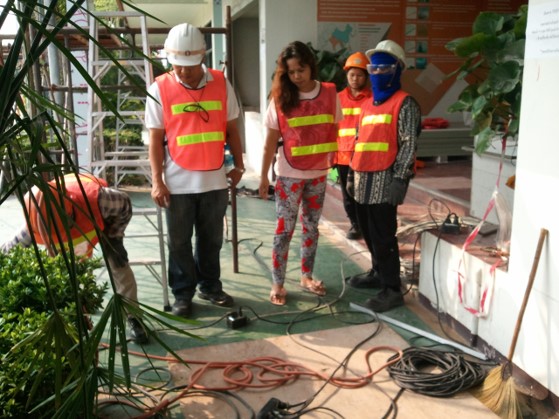

To ensure safety in a workplace is being taken as serious as other business agenda, Thailand is one of the countries that enforcing it by laws. One big question is that why Thailand still facing severe accident in workplaces continuously?
In Thailand, the Occupational Safety, Health and Environment Act B.E. 2554 (2011) and its subsequent 2022 Ministerial Regulations mandate a five-tier hierarchy for safety officers. These roles are split into two categories: Safety Officers by Position (existing staff) and Safety Officers by Specific Duty (specialized roles)
Safety Officers by Position
These roles must be held by employees already in these ranks; the employer is legally required to appoint every supervisor and manager to these roles.
- Supervisor Level: Requires a 12-hour training course (typically 2 days). Responsibilities include preparing safety manuals for their specific unit and supervising employee compliance.
- Management Level: Requires a 12-hour training course. Their primary role is to support safety policies and ensure the establishment meets legal standards.
Safety Officers by Specific Duty
These are technical or professional roles, often requiring full-time dedication depending on the company’s size and risk level.
- Technical Level: Requires 18 to 30 hours of training. This officer must now be stationed full-time at the workplace under recent 2022 updates.
- Advanced Technical Level: Requires 180 hours of specialized training. This level is for individuals with a technical certificate and several years of experience as a Technical Level officer.
- Professional Level: This is the highest tier, requiring either a Bachelor’s Degree in Occupational Health and Safety or a Bachelor’s Degree plus 5 years of experience and specialized professional training
Penalties for Non-Compliance
Failure to appoint the required safety officers can result in:
Imprisonment: Up to 6 months.
Fines: Up to 200,000 THB.
| Country | Primary Law | Mandatory Personnel? | Level/Tier System |
|---|---|---|---|
| OSHA Act B.E. 2554 | Yes | 5 Levels (Supervisor to Professional) | |
| OSH Standards | Yes | 4 Levels (SO1 to SO4) | |
| OSHA 1994 | Yes (100+ staff) | Registered SHO & Safety Committees | |
| Industrial S&H Act | Yes | Managers, Safety Officers, and Health Officers | |
| OSH Act 1970 | No (Staffing) | Focus on “General Duty” and inspections |
It seems that Thailand has the most specific requirements by laws to make safety as a part of business by enforcing organizations to has clear roles and responsibilities in safety. Why still have serious accident?
Despite the robust legal framework of the Occupational Safety, Health and Environment Act B.E. 2554 (2011), Thailand continues to face serious workplace accidents due to systemic gaps, enforcement challenges, and a lack of safety awareness.
The following factors contribute to why serious accidents still occur in Thailand:
Systemic Weaknesses and Gaps in Enforcement
- Lax Regulation and Poor Enforcement: Critics point to a failure in the overall system, citing red tape and a lack of integration in safety policies among different stakeholders. Why?
- Substandard Practices and Regulatory Evasion: Recent major incidents, such as the 2025 collapse of a 30-story building in Bangkok, were found to be fundamentally caused by flawed structural designs and efforts to evade existing regulations. Why?
- Lack of Independent Oversight: There is a reported shortage of independent safety assessors without conflicts of interest. This often leads to performance reports that do not accurately reflect the reality on the ground. Why?
Industry-Specific Risks (Particularly Construction)
- Construction consistently ranks as one of Thailand’s most dangerous industries due to several inherent factors: High-Risk Environments: Frequent use of heavy machinery (cranes, excavators), working at great heights, and exposure to hazardous materials significantly increase accident probability.
Inadequate Protocols: In many cases, accidents are tied to a lack of proper safety protocols and insufficient training for workers.
Structural Instability: Many accidents occur in buildings still under construction where structural resilience is not yet sufficient.
Human and Behavioral Factors
- Low Awareness: There is often a low level of safety awareness among workers, frequently due to a lack of knowledge regarding how to prevent occupational diseases and accidents.
- Fatigue and Long Hours: Physically demanding tasks and long working hours, common in construction and manufacturing, lead to increased fatigue and a higher risk of accidents.
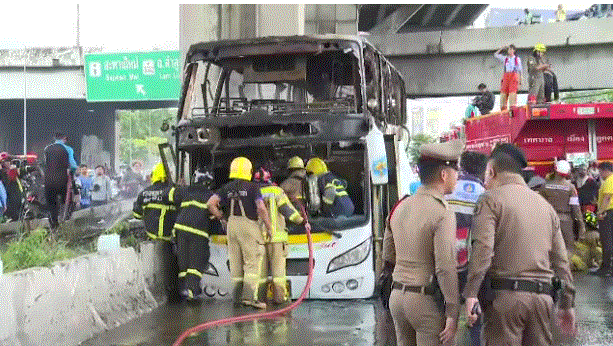
- Illicit Modifications: Some tragedies are caused by illegal equipment modifications. For example, a 2024 bus disaster that killed 23 people was linked to a vehicle being illegally modified to carry 11 gas cylinders instead of the registered six.
Data and Reporting Challenges
- Under-reporting: National recording and notification systems often fail to cover large segments of the workforce, including those in small and micro-enterprises (MSMEs), self-employed individuals, and migrant workers.
- Data Gaps: Information on occupational accidents and diseases is often incomplete because of deficiencies in recording systems. While injuries are recorded more frequently than diseases, neither is tracked satisfactorily.
Emerging Challenges
- New Hazards from Development: Rapid industrial growth has introduced new technologies and materials into the workplace, which may bring previously unknown hazards.
- Climate Impacts: Extreme weather, such as heat waves and heavy rainfall, is increasingly affecting workplace safety, particularly in outdoor industries like real estate and construction
Each year, there are thousand or more than thousands of supervisors, managers attended the classes, received certificates and being appointed to take the safety officer’s roles in their workplaces. There are more than 200 safety training companies has been registered. It means Thailand has many thousands of safety officers each year. Am I right?
